
Phoenix Sky Harbor International Airport is the main airport in Phoenix and the Valley of the Sun, Arizona. While PHX is one of the busiest airports, it is quite easy to navigate when you have knowledge about its two active terminals and the free PHX Sky Train.
Phoenix Sky Harbor has two operational terminals, Terminal 3 and Terminal 4. Terminal 2 was shut down in February 2020, thus explaining the non-consecutive numbers for the terminals. The PHX Sky Train connects both terminals to the airport parking, rental car center, and Valley Metro Rail.
Use the below Phoenix Sky Harbor International Airport map guide to find your airline, gates, security check-in, baggage claim, parking, and transportation options.
PHX Airport Map Overview
The best way to understand Phoenix Sky Harbor is to see it as an east-to-west transportation hub:
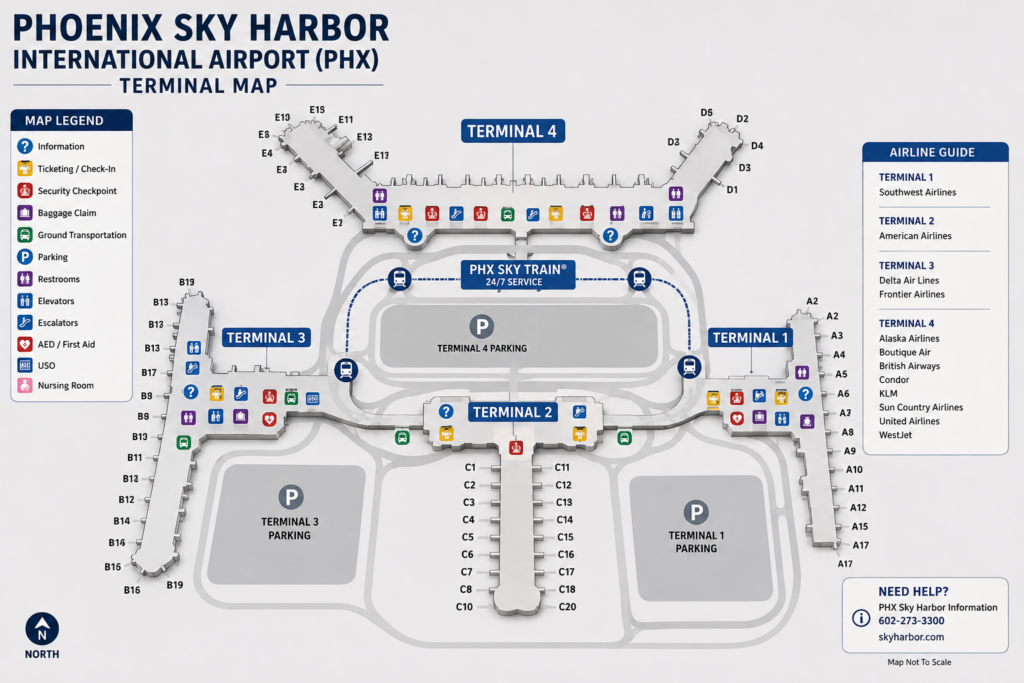
The 44th Street and Washington station links the airport to Valley Metro Rail, which provides transport to Phoenix, Tempe, and Mesa. The 24th Street station caters to west-side airport parking and accesses Buckeye Road. PHX also has an official interactive map of the airport that gives directions to various points. Visitors can use it to locate gates, dining places, shopping centers, restrooms, lounges, charging facilities, ATMs, and other services.
Terminal 3 Map: Gates E and F
Terminal 3, commonly referred to as John S. McCain III Terminal, is the smaller of PHX’s two terminals. It holds the E and F gate areas and has only one security checkpoint.
Levels in Terminal 3
- Level 1: Airline ticketing, check-in, baggage claim, information desks, and curbside transportation services
- Level 4: Security checkpoint, dining areas, shopping centers, passenger services, and access to E and F gates
- Level 5: PHX Sky Train boarding platform, accessible from the station at Level 4
Gates E are located on the north side, while Gates F are located on the south side. Estimated walking distance from the security check to the farthest gates is 910 feet to the E concourse and 1,475 feet to the F concourse. Those who have trouble walking must ask for a wheelchair in advance from their carrier.
Airlines at Terminal 3
As of August 2026, Terminal 3 facilities include Advanced Airlines, Air Canada, Alaska Airlines, Allegiant, Breeze Airways, Delta Air Lines, Denver Air Connection, Frontier Airlines, Hawaiian Airlines, JetBlue, Porter Airlines, Southern Airways Express, Sun Country Airlines and United Airlines. Changes to terminal allocations are possible, so check the airline you’re flying with according to your boarding pass.
There are lounges at Terminal 3, including Delta Sky Club at Gate F8, United Club at Gate E3 and Escape Lounge at the intersection of the E and F gate areas.
Terminal 4 Map: Gates A, B, C and D
Named after the former US Senator, Barry M. Goldwater, Terminal 4 is the biggest terminal at PHX airport. The Terminal 4 gate structure is split up into gates A, B, C and D concourses, which are built around the terminal building.
Terminal 4 levels
- Level 1: Baggage claim, taxis, rideshare pickup, shuttles, and passenger pickup
- Level 2: Airline ticket counter, baggage check, and the departures curb
- Level 3: TSA checkpoints, PHX Sky Train connection, eateries, retail outlets and walkways to all gates
There are four different TSA checkpoints at Terminal 4: A, B, C and D checkpoints. Despite their names, passengers have the option of entering any Terminal 4 checkpoint to board any Terminal 4 flight. Check the live wait times of the checkpoints prior to boarding your flight.
Most international flights that need customs processing at Phoenix come to Terminal 4. The international arrivals and customs facility is located on level 3 at the eastern side of the Terminal. Passengers coming from Canada might have gone through US preclearance before they flew.
Airlines Serving Terminal 4
Terminal 4 handles Aeroméxico, Air France, American Airlines, British Airways, China Airlines, Contour Airlines, Southwest Airlines, STARLUX Airlines, Volaris and WestJet. Double-check the airline, particularly when flying on a codeshare flight.
Some of the main lounges include three American Airlines Admirals Club lounges, the Centurion Lounge at Gate B21, an Escape Lounge at Gate B22 and the Sapphire Lounge at The Club at Gate D11. The USO can be found pre-security on Level 2.
Tips for Moving from One Terminal to Another
Transitioning from one terminal to another at Phoenix Sky Harbor International Airport (PHX) is relatively easy, particularly due to the PHX Sky Train that operates around the clock. Note, however, that it is advisable to plan your journey ahead since there may be additional time needed for security and baggage handling if a passenger transitions between two terminals.
Key tips to consider include the following:
- Using the PHX Sky Train: This free rail system links Terminal 3 and Terminal 4 and runs 24/7. Passengers with wheelchairs and mobility problems can use this system.
- Frequency of operation: The system generally runs fairly frequently throughout the day. However, trains may run less frequently from 10 pm to 5 am due to scheduled maintenance work.
- Changing terminals: If a passenger’s next flight is from another terminal, the passenger will have to exit the secure area, retrieve luggage if necessary, use the Sky Train, and re-enter the secure area.
- Contact your airline: There may be variations in procedures depending on one’s itinerary. Note especially if the flights were booked separately or with different airlines.
PHX Parking Map
The following are some of the options for parking at PHX:
- Terminal 3 Garage: The closest garage for Terminal 3 parking
- Terminal 4 Garage: The closest garage for Terminal 4 parking
- Economy garages and uncovered parking: Located near both terminals via the Sky Train
- 24th Street parking: Economy parking on the west side near the 24th Street Sky Train stop
- West Economy Garage: Convenient location for Terminal 3 and west side of the airport
- Valet Parking: For those who require direct terminal access
Parking information is subject to change. It would be a good idea to reserve your parking spot before major holidays, spring training in Phoenix, major events in Phoenix, and other peak times. There is accessible parking near elevators or Sky Train stations within the airport garages and economy lots.
Conclusion
It is easy to move around at the Phoenix Sky Harbor International Airport (PHX) once one knows about its two functioning terminals, gates, connections, and parking options. Terminal 3 is for E and F gates, whereas Terminal 4 takes care of A, B, C, and D gates. PHX Sky Train offers easy connections from terminals to parking lots, the Rental Car Center, and Valley Metro Rail. It is best to check the terminal and gate number before traveling, as it may vary depending upon the airline, security arrangements, and airport facility changes.
Frequently Asked Questions
The Southwest Airlines terminal at PHX is Terminal 4. This is the busiest terminal at Phoenix Sky Harbor International Airport, and it services many Southwest Airlines flights.
The American Airlines terminal at Phoenix Sky Harbor is Terminal 4. Terminal 4 is large and busy at times; passengers need to factor in sufficient time before traveling to cover check-in and security procedures to reach the gate.
Delta Air Lines and United Airlines fly from Terminal 3 at PHX. While Terminal 3 is less crowded compared to Terminal 4, wait times at security checkpoints may vary depending on the time of day, traffic, etc.
Yes. The PHX Sky Train is free of charge and runs 24 hours a day. This train links Terminal 3 and Terminal 4 to the economy parking facilities of the airport, Rental Car Center, and Valley Metro Rail Station.
Visitors usually have to reach Phoenix Sky Harbor Airport at least two hours prior to a domestic flight and three hours prior to an international flight. Early arrival is highly recommended during the morning departure time periods and on holiday or any other busy travel days, especially if you have to check your baggage and take off from Terminal 4.
The best choice is the official Phoenix Sky Harbor Airport map since it contains the most up-to-date data about terminals, gates, parking facilities, transportation, security checkpoints, and other facilities within the airport.