
Heathrow (LHR) has four operational terminals: Terminal 2, Terminal 3, Terminal 4, and Terminal 5 (Terminal 1 shut down in 2015 and is being demolished). Terminal 2 and Terminal 3 share Heathrow’s central area and share “Heathrow Central” station. Terminal 4 is located south of the airport, and Terminal 5 is separate from the other three, located to the west of them. All four terminals are connected by free inter-terminal trains, the Piccadilly line, and buses, so moving from one to another is free of charge.
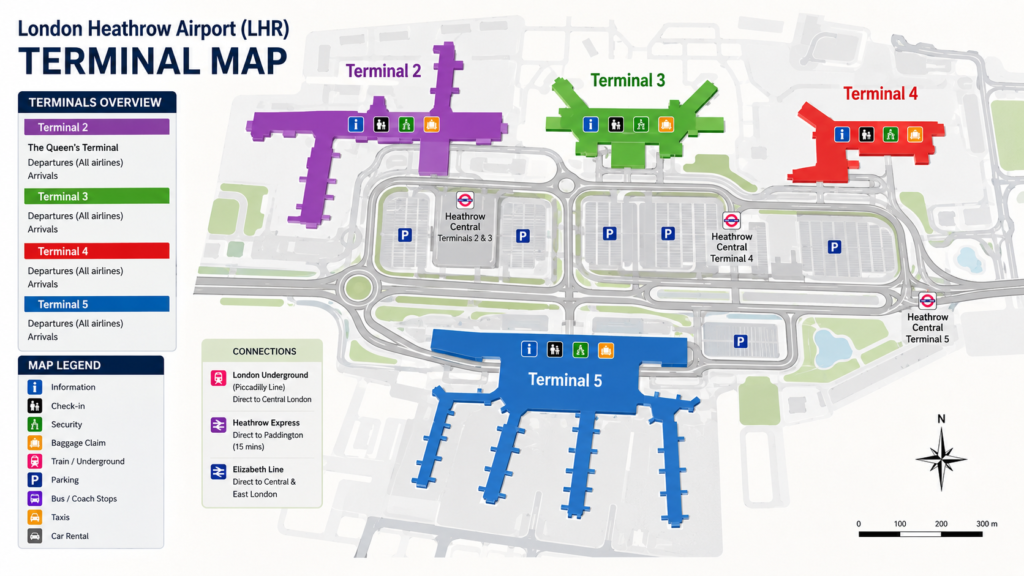
If you have ever been struggling with figuring out where your boarding gate is, how to get to the Elizabeth line, or how far Terminal 5 is from Terminal 3 on the Heathrow terminal map, this guide will explain everything about Heathrow Airport in simple language – without jargon and guesses.
Heathrow Airport Layout Overview
Visualize Heathrow’s two runways that run in an east-west direction. In relation to them, there are three zones containing the airport’s terminals:
- Central zone: Terminal 2 and Terminal 3, located near the center of the airfield, are linked to each other by an indoor corridor (about a 10-minute walk).
- Southern zone: Terminal 4, located near the cargo facilities and airport hotels.
- Western zone: Terminal 5, the newest and biggest of Heathrow’s terminals, is separate from all others, with its own railway station.
On any official map of Heathrow Airport and in the Heathrow app, Terminals 2 and 3 will be marked collectively as “Heathrow Central.” That’s also where the Central Bus Station and the hub of rail and Underground services for the entire airport are located.
Terminal by Terminal
Here is the detailed guide terminal by terminal for easy and better understanding.
Terminal 2 – “Queen’s Terminal”
In the middle of Heathrow, Terminal 2 is home to most Star Alliance carriers, including United Airlines, Lufthansa, Singapore Airlines, Turkish Airlines, and Air Canada. Terminal 2 is one of the newest terminals in the central zone of Heathrow.
Terminal 3
Right next to Terminal 2, Terminal 3 is one of the busiest airports for oneworld airlines other than British Airways, including various independent long-haul carriers. You will see American Airlines, Cathay Pacific, Qantas, Japan Airlines, and Finnair operating from Terminal 3, in addition to Virgin Atlantic and Delta Airlines, who operate their transatlantic partnership from T3. Emirates airlines operates out of Terminal 3 as well. Some long-haul and seasonal flights of British Airways operate from T3 as well, in addition to their main terminal, which is Terminal 5.
Terminal 4
Terminal 4 is not part of the main group of terminals and is located closer to the cargo facilities of the airport. This is where you will find SkyTeam members including Air France, KLM, Korean Air, Saudia, and Vietnam Airlines in addition to Qatar Airways, Etihad, Malaysia Airlines, and Royal Air Maroc. Being physically separated from the other terminals, it requires you to take a shuttle bus or train to get there from Heathrow Central.
Terminal 5
Terminal 5 is the largest at Heathrow and serves only British Airways and Iberia, and is one of three world hubs for IAG. Terminal 5 is located in the western part with its own rail and Underground station, and satellite terminals T5B and T5C used for BA short haul European departures. So, if you are flying with BA to a major hub such as New York, Los Angeles or Chicago, you will be departing from here.
Terminal cheat sheet:
- T2 – Star Alliance (United, Lufthansa, Singapore, Turkish, Air Canada)
- T3 – oneworld (excluding BA), Virgin Atlantic, Delta, Emirates
- T4 – SkyTeam, Qatar, Etihad, Malaysia Airlines
- T5 – British Airways, Iberia
Occasionally, there may be changes in airline terminal allocations, so it is better to check the terminal on the boarding pass or the departures board.
Traveling Between Terminals
Heathrow’s airport map shows three options how to get around at the airport airside and landside:
- Free inter-terminal trains – The Elizabeth line and Heathrow Express travel between Heathrow Central (T2 & T3) and Terminal 5, and this is free as long as you are traveling within the ticketed area of the Heathrow stations.
- Piccadilly line – The Piccadilly line of the London Underground goes to all the terminal stations, although you have to make a connection between Heathrow Central/Terminal 5 and Terminal 4 at Hatton Cross.
- Bus transport – There is a free shuttle bus that will take you from Terminal 4 to Heathrow Central rail station for people who don’t want to travel on the train.
Example route: If you arrive at Terminal 2 and have to check into Terminal 5, then follow the “Trains” signs from the arrivals hall at T2 down to the Heathrow Central platform and get on any Elizabeth line/Heathrow Express train bound for Terminal 5. Your total travel time should be around 30-45 minutes.
Reading the Map: Navigation Hints
The Heathrow physical and online maps share the same iconography; therefore, having learned the system, no terminal will be confusing anymore:
- Train icon – denotes the closest Elizabeth line, Heathrow Express, or Underground platform.
- Bus icon – points to the Central Bus Station and/or shuttle buses that operate from particular terminal.
- Blue accessibility symbol – designates step-free paths and lifts; all four terminal stations are step-free from the street level to the platform.
- Departures/Arrivals segregation – almost all terminals have departures and arrivals located on different levels; thus, the map and the signage above will always show you whether you should move upwards or downwards.
If you navigate the airport online, the Heathrow app provides the same interactive map as at heathrow.com, allowing you to zoom into the particular terminal and to get more information by tapping a shop/gate icon or drawing a path between two points of the airport. It is always the most accurate tool in terms of up-to-date information, as the physical maps may fall behind the construction or closure of some car parks, such as the current Terminal 4 works.
Conclusion
Prior to traveling, it is best to take into account some of the live service updates at Heathrow Airport that can influence the quickest way across the map such as the planned maintenance work, labor strikes on the Piccadilly line, and airport renovations (for instance, the temporary closure of Terminal 4 car park). In any case, the free inter-terminal train from Heathrow Central is the quickest way to go.
Frequently Asked Questions
Four functioning terminals – 2, 3, 4, and 5. Terminal 1 shut down permanently in 2015 and is currently being demolished as part of the long-term expansion projects of Terminal 2.
Terminal 5 for most of the British Airways flights, but there are some long haul and season flights using Terminal 3.
Only between Terminals 2 and 3 where there is an indoor walkway connecting both that takes about 10 minutes. Terminals 4 and 5 use the train, underground and the shuttle bus.
Yes. Transfers between terminals using the Elizabeth line, Heathrow Express, Piccadilly line, and the shuttle bus are all free of charge.
It will take approximately 30-45 minutes, including the time to walk to the station, take a train, and then reach your terminal for check-in.
The official site of Heathrow Airport (heathrow.com) provides you with interactive maps of the terminals that include roadways, parking lots, shopping centers, stations, and gates.