
Orlando International Airport (MCO) is one of the busiest airports in Florida and acts as an important entry point for travelers going to Orlando, Walt Disney World, Universal Orlando Resort, and other places of interest in Central Florida. Since MCO is a large airport that consists of several terminals, gates, parking facilities, and transportation points, having a look at its airport map before your arrival can really help.
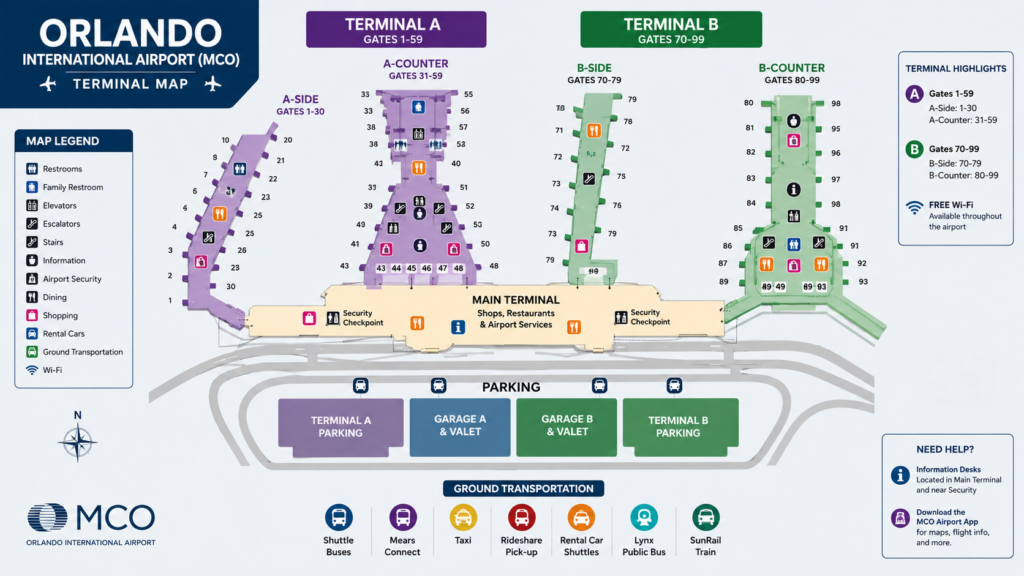
Currently, there are three terminals at MCO: Terminal A, Terminal B, and Terminal C. Terminals A and B comprise the North Terminal complex at the airport while Terminal C is part of the South Terminal complex at the airport. Official website of the airport provides interactive and downloadable terminal maps.
A Quick Guide to MCO Airport Map
The simplest way to comprehend the airport map of MCO is to segregate the map into three main components:
- Terminal A – Located at the North Terminal Complex providing check-in services, baggage claim, ground transport, and access to Airside 1 & Airside 2.
- Terminal B – Located at the North Terminal Complex providing check-in services, baggage claim, ground transport, and access to Airside 3 & Airside 4.
- Terminal C – Located at the South Terminal providing check-in, security, baggage claim, gates, parking link, and ground transportation.
North Terminal utilizes airside gate locations such as Gates 1–29, 30–59, 70–99, and 100-129. Terminal C utilizes Gates C230-C245, but with more gate locations becoming available during the terminal expansion until 2026.
It should be noted that your airline’s terminal and gate are not necessarily the same things. Using the landside terminal to check-in for your flight, you need to move to the right airside gate location using an automated people-mover system.
Terminal A and Terminal B Map
Terminals A and B are situated in one building making North Terminal relatively easy to navigate even with two separate names.
Terminal A
Terminal A lies at the eastern part of the North Terminal. Passenger facilities in this Terminal are arranged on three major levels.
Level 3: This is the departure level, which houses airline check-in facilities for passengers. It also features security screening and transportation to gates.
Level 2: This is the baggage claim level, with bag carousels 1-16 for Terminal A.
Level 1: Ground transportation, rental cars, shuttle services, buses, taxi services, and other means of passenger transport facilities are provided at this level.
Terminal B
Terminal B is in the western part of the North Terminal.
Level 3: This level has airline check-in and departure facilities.
Level 2: The main baggage claim level with carousels 20-32
Level 1: Bus services, rental cars, shuttles, taxi services, resort transport, and other ground transportation facilities are available at this level.
Passengers who will be using the North Terminal are advised by the airport to verify the terminal of the airline before arrival. They may also opt to park in the garage of the same terminal to minimize walking distance.
MCO Airside and Gate Map
One of the most essential parts of the Orlando airport map is the link between the terminal building and the airside gate locations. The gates at the North Terminal are grouped into four airside sections as follows
| Airside | Gates |
|---|---|
| Airside 1 | Gates 1-29 |
| Airside 3 | Gates 30-59 |
| Airside 4 | Gates 70-99 |
| Airside 2 | Gates 100-129 |
These gates are confirmed by the airport’s published airline access information. The passengers do not walk straight from the check-in counters to the gate areas; there is an automated people mover system linking the terminal building to the airside facilities.
As an example, Gates 1-29 and Gates 30-59 are accessed via the security checkpoint in the western part of Terminals A and B. Gates 70-99 and Gates 100-129 are found in the eastern part. The airport claims that passengers can travel between some gate sections via Gate Link within the secure area.
Terminal C Map
Terminal C is part of the newer South Terminal complex of MCO, with its own unique map compared to Terminals A and B.
The map of Terminal C includes some key passenger levels.
Level 6 – Arrivals
At Level 6, there is a baggage claim, Customs and Border Protection facility, and the Meet & Greet Area. The level is used by international arriving passengers at Terminal C.
Level 4 – Parking and Transportation
Connections to Garage C and the Ground Transportation Facility can be found on Level 4. It is also equipped with passenger facilities like rental car services and a nursing room.
Level 2 – Departures
Airlines check-in takes place at Level 2. There is access to the security checkpoint and departures there.
Level 1 – Ground Transportation
Access to the out-of-town shuttles, resort transportation, parking shuttles, and other related services is provided on Level 1.
Terminal C is currently equipped with gates in the range of C230-C245, with additional gates in the range of 250-254 introduced in the 2026 airport expansion project. The expansion of 2026 was accompanied by the move of Virgin Atlantic from Terminal A to Terminal C.
Getting Between MCO Terminals
If you have an incoming flight in Terminals A or B but the departure is in Terminal C, there is a special people mover – Terminal Link which links the North and South Terminal Complexes. As indicated in the information provided by the airport, the Terminal Link will take you from Terminal C to Terminals A and B within four minutes. The Station to Terminals A and B is situated on Level 3.
There is also the option of using a terminal shuttle bus. As indicated by the MCO, the Terminal Link Shuttle Bus runs 24 hours a day, with the pickup and drop-off locations in Terminal C Level 1 and Terminal B Level 1. In terms of connecting flights, MCO advises following the necessary signs rather than thinking that the whole complex is linked by one easy-to-use indoor corridor.
Ground Transportation Map at MCO
The MCO map can be used when trying to find ground transportation as well. The ground transportation is situated mainly on Level 1 at Terminals A and B, while baggage claim is situated on Level 2 and departures/ check-in are on Level 3.
Depending on the terminal, one can get the following:
- Rental cars
- Taxis
- Ride-sharing service
- Air and hotel shuttle
- Resort transportation
- Buses
- Parking shuttles
- Intercity transportation
The importance of Terminal C for rail passengers cannot be overstated since it is linked with MCO’s intermodal transportation hub. Brightline runs out of the Orlando station and offers intercity rail transport services between Orlando and South Florida cities.
Tips for Using Orlando Airport Map
To make things easier during your journey at MCO, try the following:
1. Consult your airline first. This will decide what terminal and check-in area you use. Assignments vary and therefore it is important that you confirm your flight prior to departure from home.
2. Check your gate upon arrival at the airport. The gate number indicated on your boarding pass might be changed. Use the live information on the airport website and signs inside the airport.
3. Familiarize yourself with the levels at which each terminal operates. In Terminals A and B, Level 3 is departure level; Level 2 is where you pick up luggage, and Level 1 is where you get to your ground transportation. Terminal C is different.
4. Account for additional time needed in case of terminal transfers. If you have to transfer between Terminals A/B and Terminal C, take Terminal Link Shuttle rather than trying to travel through the airport via roads.
5. Utilize the official interactive map. Interactive airport map is provided by MCO, as well as downloadable versions of Terminal A&B and Terminal C.
6. Stay aware of current construction projects. MCO is continuously expanding its facilities. Current projects page on the airport website provides information about construction in all three terminals.
Conclusion
It becomes much easier to read the map of the Orlando International Airport (MCO) if one knows how it is subdivided into three passenger terminals and gate areas. The North Terminal includes Terminal A & B, and there are gates 1-129 that can be reached via four airside areas. Terminal C is considered the South Terminal that has gates in the C230s plus expanded gate areas.
Travelers will find it useful to learn the following facts about the airport: check your terminal, confirm your gate, find out what level you should go to, and leave some time if you are connecting between the North and South Terminal complexes. It is convenient to connect between the complexes with the help of the Terminal Link; and MCO’s official interactive and static maps will give you the latest information.
FAQ
Orlando International Airport currently has three passenger terminals, which are Terminal A, Terminal B, and Terminal C. Terminals A and B are in the North Terminal complex, while Terminal C is in the South Terminal complex.
The gates at the North Terminal are grouped into four categories: Gates 1-29, 30-59, 70-99, and 100-129, depending on the airside which you will be using.
One can use the Terminal Link automated people mover to travel from the North Terminal to the South Terminal complex. According to MCO, it will take only about four minutes for the trip. A 24-hour terminal shuttle bus is also provided.
The baggage claim area at Terminals A and B is at Level 2. At Terminal A, passengers use baggage carousels 1-16, while at Terminal B, the baggage carousels used are 20-32. At Terminal C, the baggage claim area is at Level 6.
Yes. The Orlando International Airport offers an interactive map in addition to maps that can be downloaded for Terminal A & B and Terminal C.