
One of the busiest airports in Europe, Frankfurt Airport (FRA) processes around 60 million passengers annually throughout its terminals, concourses, and rail stations. Regardless of whether you need to make a connecting flight on time, wait for somebody in arrivals, or just want to locate the closest lounge facility, a proper map of Frankfurt Airport will help you get through your journey faster than ever before.
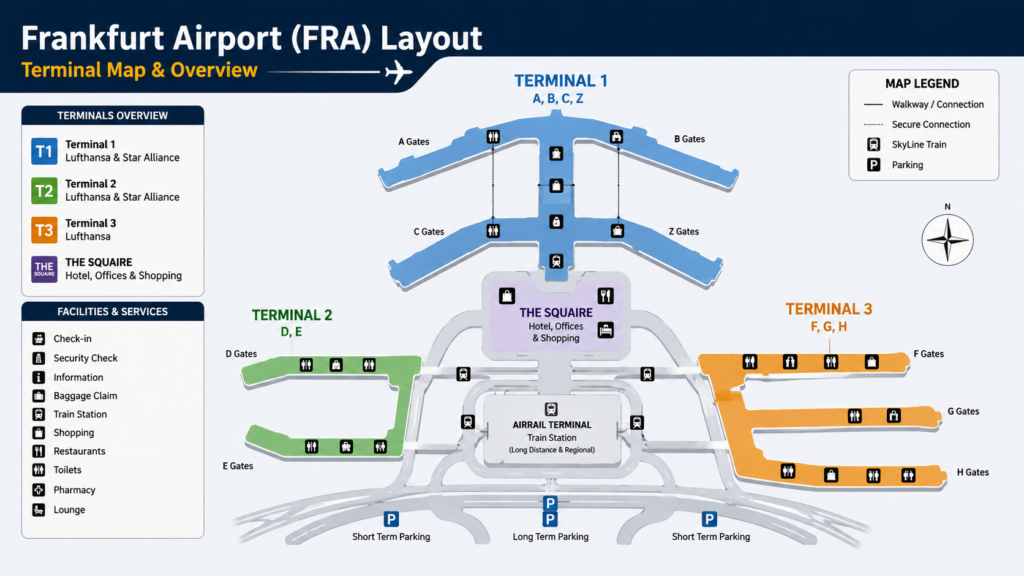
The following guide provides you with a simple explanation of Frankfurt Airport’s layout and structure, including every single terminal, connections between them, as well as locations of important facilities like security checkpoints, rail stations, lounges, and dining facilities. The guide takes into account the layout of the airport up to the year 2026, with the opening of the new Terminal 3.
Overview of Frankfurt Airport Terminals
FRA consists of two main passenger terminals:
- Terminal 1 – the original and largest terminal divided into concourses A, B, C, and Z. This is the main gateway for Lufthansa and Star Alliance airlines and offers over 100 gates on several levels.
- Terminal 3 – the latest addition to the airport, inaugurated on April 22, 2026. It now accommodates all flights previously handled by Terminal 2, which is under renovation. Terminal 3 handles oneworld, SkyTeam, and other non-Lufthansa Group airlines.
If the last time you were at Frankfurt Airport was prior to April 2026 and your flight left from Terminal 2, it definitely relocated to Terminal 3. Always check your terminal in advance, as airline assignments may still be changing during the transition process.
Terminal 1: Concourses A, B, C, and Z
Terminal 1 is best described using what experienced travelers refer to as the “Schengen split”:
- Concourses A and the lower levels of Concourse B cater mostly to the flights to the Schengen Zone, where there is no need for passport control due to the area’s borderless structure.
- Concourses Z, C, and the upper levels of Concourse B are designed for international flights outside the Schengen Zone, requiring passport control.
Terminal 1 comprises several floors, with arrivals mostly below and departures above. Since the concourses are well spaced, walking time between them may be considerable: allow about 5 to 10 minutes between two adjacent concourses (e.g., A and B), and 15 minutes or more between other concourses, e.g., A and C. There is a tunnel between the B and A piers to move across the terminal without having to use the SkyLine.
Terminal 3: The New Hub
Terminal 3 is a relatively new, specially built terminal designed to alleviate congestion in FRA and replace the outdated Terminal 2. It now accommodates the airlines and routes operating from the old Terminal 2, which include mainly the airlines of the oneworld and SkyTeam alliances. Being a new terminal, some signage, lounge facilities, and stores may not be ready yet, and visitors need to expect some extra time until they familiarize themselves with the terminal.
Connecting Between Terminals: The SkyLine
The SkyLine is an automated train system of Frankfurt Airport that serves the purpose of moving passengers between the terminals. Important things about the SkyLine:
- It operates between 4:00 a.m. and 11:00 p.m. The frequency of the trains is one every 2-3 minutes.
- The stations are located in Terminal 1 and Terminal 3.
- From 10:00 p.m. to 5:00 a.m., when the SkyLine is not working, shuttle buses connect the terminals from stops located in the arrivals forecourt areas.
- It should be noted that SkyLine cars are usually divided according to passengers’ nationality (Schengen vs. non-Schengen), therefore, you should look carefully at signs and get on the appropriate car for your future destination.
If you are going to connect between Terminal 1 and Terminal 3, allow at least 20-30 minutes to complete the whole procedure, including your travel on the SkyLine and possible passport control at the end of the trip.
Train Stations at FRA
Frankfurt Airport is located above two railway stations, which can be reached from Terminal 1:
- Regionalbahnhof (Regional Station) – the station is served by S-Bahn trains S8 and S9, connecting Frankfurt Airport to Frankfurt Hauptbahnhof and to the regional network.
- Fernbahnhof (Long-Distance Station) – the station is served by ICE trains (InterCity Express).
Both stations make FRA an authentic “airport train station,” which becomes helpful in connecting flights without an additional security check when you arrive by rail from some partnering routes.
Security, Passport Control, and Tips on Passing the Checkpoint
The security checkpoints are located in every concourse and not in one centralized place; thus, the location of your checkpoint will depend on the gate area you depart from. Passport control is necessary in cases of transfer between the Schengen and non-Schengen areas; this is the key reason that determines the amount of time you will spend walking across the airport, and it is recommended to be aware of that before planning your time.
The main tip: always follow “Connecting Flights” or “Transfer” signs but not “Ausgang” signs in German (which means “exit”) in case you are not leaving the airport.
Ways to Navigate FRA Airport Using a Map
In your study of Frankfurt airport maps, the following points that are constant should be used to guide you instead of trying to remember all concourses:
- SkyLine stations – your constant anchor points between Terminal 1 and Terminal 3.
- Schengen/non-Schengen line – this is the point to determine whether you will clear passport controls.
- Regionalbahnhof/Fernbahnhof – anchor points if you arrive or depart using trains.
- Concourses (letters A, B, C, and Z in Terminal 1) – consider these neighborhoods rather than in sequence, because they don’t have linear order.
Conclusion
The 2026 Frankfurt Airport layout map may seem quite complicated, but once you find out the important landmarks, it will not seem difficult anymore. These include Terminal 1 with Lufthansa and Star Alliance airlines, the newly built Terminal 3 with oneworld and SkyTeam airline companies, and SkyLine that represents the quickest connection between terminals. With the help of Regionalbahnhof and Fernbahnhof railway stations and their connections, Frankfurt Airport will become much easier to navigate in spite of its huge size. You will always be able to transfer between concourses or g o to a railway station or a lounge thanks to SkyLine stations and the Schengen border.
FAQs
Currently, Frankfurt Airport has two passenger terminals – Terminal 1 and the recently opened Terminal 3. The other passenger terminal at FRA, Terminal 2, was closed in 2026 for a major renovation, and all its flights have been relocated to Terminal 3.
One option for traveling between the terminals is the free SkyLine shuttle train that operates between Terminals 1 and 3 at two- to three-minute intervals around the clock, but during off-peak hours, passengers can use the shuttle bus instead.
Terminal 2 has been closed for a large-scale renovation, while all airlines and flights operated out of it – mostly those associated with oneworld and SkyTeam alliances – have been relocated to the newly opened Terminal 3. The latter opened for operations on April 22, 2026.
Lufthansa and other members of the Star Alliance operate out of Terminal 1. Terminal 3 currently serves the oneworld, SkyTeam, and other non-Lufthansa Group airlines that previously flew out of the old Terminal 2.
Yes. There are two train stations situated below Terminal 1 at the Frankfurt Airport, one of them serving the S-Bahn regional train line S8 and S9, while the second one – the Fernbahnhof – connects the airport to other German and European cities via ICE high-speed trains.