
Brussels Airport (IATA: BRU, ICAO: EBBR) is Belgium’s largest and most popular airport, located in Zaventem in the province of Flemish Brabant, at about 12 km (7.5 miles) northeast of the center of Brussels. The airport is the home of Brussels Airlines (a member of Star Alliance) and TUI fly Belgium, and BRU handled about 23.6 million passengers in 2024, ranking among the busiest European airports.
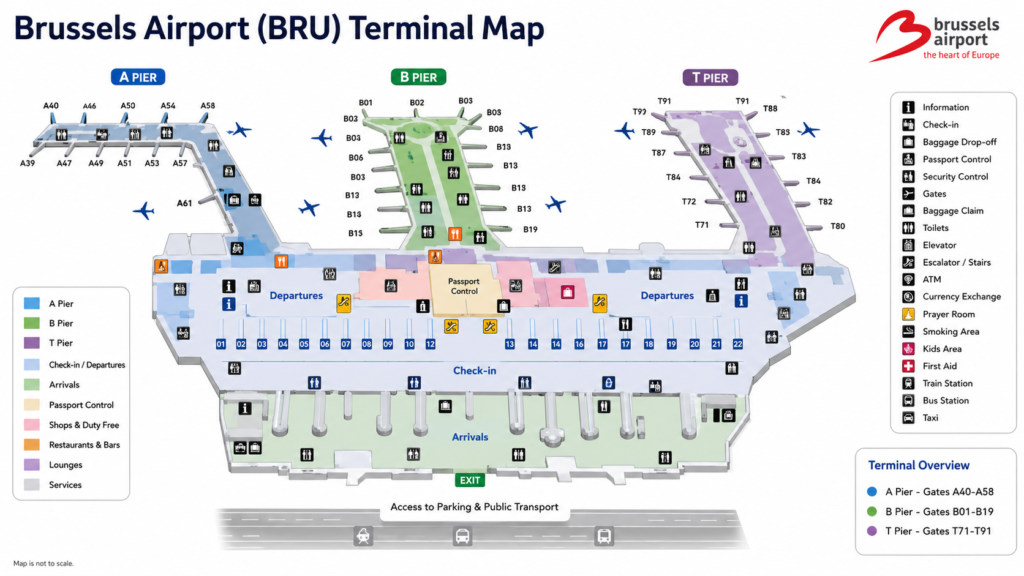
The airport does not have many separate terminals; it is a single terminal facility. All the procedures that you usually have to go through in an airport (check-in, security, shopping, dining, and gate access) take place within one building divided into two piers. Knowing how it works is the first step towards comprehending the BRU airport map and finding your way in the airport when landing or departing.
Overview: Single Terminal & Two Piers
Unlike “Terminal 1” and “Terminal 2,” there are Pier A and Pier B at Brussels Airport, connected by the Connector.
- Pier A: The relatively new pier, utilized for flights within the Schengen area. Additionally, it is home to the “T-Gates,” which are used by Brussels Airlines to connect to long-haul flights to New York and Africa.
- Pier B: The older pier, reserved for non-Schengen flights, meaning destinations that are outside of the EU open-border agreement, which includes not only the UK but also long-haul flights served by Emirates, Qatar Airways, Etihad, Cathay Pacific, and Delta.
- The Connector: This is an above-ground walkway connecting Piers A and B in the airside of the airport. It also contains the airport’s main security check, meaning that all passengers will pass through here before going to their appropriate pier.
As Piers A and B cater to separate passport control areas, changing from one to another (such as going from a Schengen flight to a non-Schengen one) requires going through border control. Some extra time should be factored in when connecting here.
Levels Explained: Floor by Floor Guide
Brussels Airport is arranged vertically in several floors, and understanding on which level you need to be on will allow you to avoid going in circles.
| Level | What’s There |
|---|---|
| Level 3 | Departures Hall – check-in desks, self-service kiosks, bag deposit and entrance to security control |
| Level 2 | Arrivals Hall – baggage reclaim, customs clearance, meeting points, and taxi entrance |
| Level 1 (Pier level) | Boarding gates, duty-free shopping and cafes, and airline lounges in Pier A and Pier B |
| Level 0 | Bus stops and entrances/exits in the vicinity of the terminal |
| Level -1 | Ticket office at the railway station |
| Level -2 | Platforms of the train station from Brussels and further |
Remember that the levels “Departures” and “Arrivals” are located right on top of each other, while the railway station is located below both of them.
Departures: Check-In and Security
In the Departures Hall on Level 3, you will finally begin your adventure in the BRU airport. The check-in counters are divided into zones that are numbered, and for many airlines there are self-service kiosks and automated bag drop. Passengers should proceed via the Connector through to security.
Here are some tips for departures:
- Always leave yourself ample time as one of the busiest airports in Europe, BRU can experience queues during peak traffic hours, particularly early mornings and late afternoons when there are flights scheduled back to back.
- Throughout the Departures Hall, screens will indicate your check-in counter and then later your boarding gate – always verify your gate before making your way to the piers, as gates are often changed.
- From the security point, you should follow the signs overhead – the general direction of Pier A gates is straight ahead, while Pier B gates branch off to the side.
Pier A: Schengen Flights and the T-Gates
Pier A is the bigger and more modern pier compared to the other. It occupies two floors, where shops, cafés, and lounges are located on the first floor, and the gates are located on the second floor. Most of the European flights that depart from here are Brussels Airlines flights and Star Alliance flights for short- and medium-distance travel within the Schengen area. There are T-gates within the Pier A area which are utilized by Brussels Airlines for their long-haul flights to some parts of Africa and North America.
Pier B: Non-Schengen and Long-Haul Flights
Pier B is the old one, which is connected to the main Departures hall. This pier accommodates all flights departing outside the Schengen Area, such as flights to the UK, the Middle East, Asia, and all other intercontinental flights. These flights require passport and border checks; hence, Pier B contains dedicated passport checkpoints for departures and arrivals, and this could sometimes lead to queues during the arrival of many wide-bodied flights at the same time.
Arrivals: What To Expect On Level 2
Upon arrival, passengers at BRU enter the Arrivals Hall on Level 2. Here, passengers will notice that:
- For non-Schengen arrivals, there is passport control before entering the baggage reclaim area.
- For Schengen arrivals, there is direct access to the baggage reclaim area and the exit from the airport.
- There is a meeting point marked in the Arrivals Hall, alongside directions down to the railway station and out to taxis and buses.
How To Get To and From The Airport
The transportation hub for the airport in Brussels has excellent links via train, road, and bus networks and is located right underneath the terminal building.
- Train: The Brussels Airport-Zaventem railway station is located on Levels -1 (tickets) and -2 (stations) directly underneath the terminal. Trains are operated by SNCB/NMBS and are frequent, running every few hours between Brussels-North, Brussels-Central, Brussels-South and onwards to other cities in Belgium and neighboring countries. It should be noted that tickets bought to and from the airport have an extra rail surcharge known as the Brussels Airport Supplement (previously known as Diabolo).
- Bus: The public bus system includes intercity and city bus routes that leave Level 0 in front of the terminal.
- Taxi: Metered taxis can be found right outside the Arrivals Hall.
- Car & Parking: The airport provides several car parking zones which are typically denoted as P1-P4. While the P1 and P2 parking spaces are close to the terminal and best for shorter periods of time, the P3, P4 and shuttle parking are more suitable for longer stays and offer lower prices per day.
Facilities You Need to Know About
Once you pass through security, you will have plenty of dining, shopping and resting opportunities available at Brussels Airport, located across two piers:
- Restaurants offering cafes, bars and food takeaway, with Belgian and international restaurants available.
- Stores, such as duty-free shops selling fashion clothes, electronic devices, jewelry and other gifts, with Belgian delicacies (chocolate) also being sold here.
- Lounges provided by airlines, with Brussels Airlines’ lounges located both at Pier A and Pier B.
- Wi-Fi connection and chargers available for free in most gates.
Tips for Using the Map at BRU Airport
Some of the tips that the experts give regarding using the map at the BRU airport are:
- Find out your pier (either A or B) allocation as early as possible since it will tell you where you need to head at the Connector point.
- Should your trip require connecting flights that are Schengen and non-Schengen, budget additional time for the border crossing.
- Pay attention to the overhead signs for directions, which have colour-coded information throughout the terminal and will make it easier for you to navigate without a printed map.
- In case you arrive at the airport by train, keep in mind that the train platforms are on the lower level than the terminal building.
Conclusion
The structure of Brussels Airport is easy to understand if you know its essence: one terminal, two piers, and a Connector connecting everything. Pier A serves the Schengen countries and specific long-haul airlines, Pier B serves other flights, and the levels go in an understandable order from the train platforms at the lower levels up to the Departures level 3. No matter whether you are flying to another European country or traveling by long-haul flight, spending some time figuring out which pier, level, and connection you use will be useful when studying the BRU airport map.
Frequently Asked Questions
No. There is only one terminal building at BRU divided into two piers: Pier A and Pier B, which are connected via the Connector.
Pier A mostly deals with flights to the Schengen zone (and some long-haul Brussels Airlines flights via the T-gates), while Pier B serves only international flights.
This can be done on foot using the Connector, although since they have different border zones, you will have to go through passport control if you are moving from a Schengen flight to a non-Schengen one.
It can be found right under the terminal, where ticketing takes place on Level -1 and where platforms are on Level -2.
Belgium’s Brussels Airlines and TUI fly Belgium operate out of BRU as their home base, along with many other international airlines.