
Minneapolis-St. Paul International Airport (MSP) has two distinct terminals, Lindbergh Terminal (1) and Humphrey Terminal (2) – spaced three miles apart from each other with no enclosed link between them. Terminal 1 consists of seven concourses (A-G) and more than 115 gates, while Terminal 2 comprises one concourse (H) with 16 gates. There is an easy-to-use free connector connecting the terminals – the METRO Blue Line light rail, that takes about two minutes and operates 24/7.
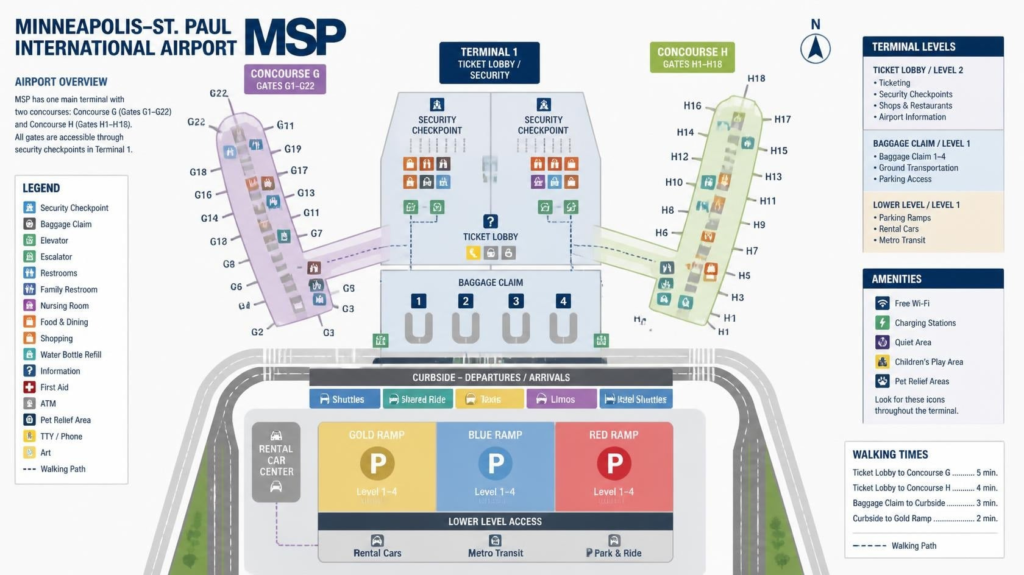
When traveling from MSP for the first time, or having a tight connection, the fact that there are two terminals in this airport is the most important thing to know before heading to the airport. Here we have prepared a detailed map guide for both terminals, their parking, transportation options, security screening, and common travel mistakes.
MSP Highlights
- Airport code: MSP (KMSP)
- Terminals: 2 (Lindbergh Terminal and Humphrey Terminal)
- Distance between terminals: about 3 miles (not walkable), no enclosed connection
- Concourses: A, B, C, D, E, F, G (Terminal 1); H (Terminal 2)
- Connector: METRO Blue Line light rail
- Hub airline: Delta Air Lines (Terminal 1)
- Low-cost hub airline: Sun Country Airlines (Terminal 2)
First of all, make sure that you have found out which terminal you are flying from by checking your boarding pass or using the airline’s app.
Terminal 1 (Lindbergh): Main Terminal
Terminal 1 is the bigger terminal at MSP Airport. This terminal is the hub of Delta Air Lines as well as the home of American, United, Alaska, Air Canada, Air France, KLM, Lufthansa, Aer Lingus, Spirit, and WestJet airlines. It consists of seven concourses in the form of a “broken-H,” where Concourses C and G make the legs.
Concourse layout:
- Concourses A and B: They are the closest to the middle part of the terminal building and can be accessed by underground tram.
- Concourse C: It is a long concourse with an underground tram, stopping at three stations and branching off to connect to A and B concourses in the vicinity of gate C27.
- Concourses D, E, and F: They accommodate both domestic gates and are connected through the MSP Mall, the middle shopping and dining area.
- Concourse G: This is the furthest concourse and takes care of most of the international arrivals as well as many of the Delta gates.
Traveling between concourses: Walking from one end to another in Terminal 1, like from Concourse A to Concourse G, can take 15-20 minutes. Trains traveling underground in Concourse C provide the fastest option for getting to one end from the other end without walking the entire length of the terminal. However, moving walkways ease movement on long stretches; thus, extra travel time should be allowed in case the gates are located at different ends.
Arrival of international flights: International flights arriving into Minneapolis-St Paul Airport will either land in Concourse G at Terminal 1 or in Terminal 2; thus, check which terminal the international flight will land in case of an onward connection.
Terminal 2 (Humphrey): The Budget Terminal
The second Minneapolis-St Paul airport terminal, known as Humphrey Terminal because it was named after the former Vice President Hubert Humphrey, has only one concourse, H, with 16 gates.
Due to the fact that everything is at one concourse level, Terminal 2 is much more easily accessible than Terminal 1 – most people are able to walk from the check-in point to any gate in less than 10 minutes. All of the ticketing, baggage claim, rental cars, and ground transportation are at one level, and there are two security checkpoints, situated close to the Orange and Purple ramp skyways.
Moreover, Terminal 2 has become one of the busiest places in MSP: in 2024, it reached its annual passenger record by serving more than 6.8 million travelers, which is one of the reasons why right now Terminal 2 is going through an extensive expansion process (details of which are provided below).
Getting From Terminal 1 to Terminal 2 and Vice Versa
This is probably the biggest challenge faced by MSP passengers. These terminals are not interconnected by means of security control – there is no passage, tram, or concourse that connects the two terminals. There are two possibilities:
- METRO Blue Line light rail (recommended): It’s free between the two airport stations, comes every 10-20 minutes, runs all night, and takes just a couple of minutes to get from one station to another. The Terminal 1 station is underneath the Red, Blue, and Silver ramps and can be accessed by taking the tram level, located one floor below baggage claim. The Terminal 2 station is on the north side of the Orange Ramp and can be accessed on Level 1, near ticketing.
- Driving/rideshare: Each terminal has its own exit roads, so be sure that your ride is heading to the right terminal as sometimes GPS will direct you to the wrong one.
Since you will have to exit security to make the connection between terminals, plan ahead and allow for 30-45 minutes of extra time, especially if you need to re-check security in Terminal 2.
Parking map: Ramps by Terminal
MSP uses color-coded, covered parking ramps at both terminals.
- Terminal 1 Ramps: Green, Gold, Blue, Red, Silver, Pink, and Brown. The Green and Gold ramps are the ones nearest the ticketing area and are connected by a Level 3 enclosed skyway walkway – so there’s no need to walk outside. The Blue, Red, Silver, Pink, and Brown ramps are connected by the Level T tram. The Blue line light rail train station is located directly below the Red, Blue, and Silver ramps.
- Terminal 2 Ramps: Orange Ramp (Value Parking) serves as the main ramp and is linked to the terminal through a skyway, where the light rail station is located on the north side. There is an additional Quick Ride Ramp that provides a free 24-hour curbside shuttle service to both terminals; this is the only ramp at MSP airport with a shuttle that takes passengers to both sides of the airport.
- Valet Parking is provided at Terminal 1 on the upper east roadway of Door 2.
Security & MSP Reserve
There are several security checkpoints in each of the terminals – Terminal 1 always maintains at least one checkpoint at the ticketing level, and there are two checkpoints near the Orange and Purple Ramp skyways at Terminal 2. The airport also provides MSP Reserve Program for free, which allows making a reservation of the security screening time up to seven days in advance at designated checkpoints. There are no membership requirements to use this service.
Conclusion
The only thing that every traveler needs to be familiar with before reaching the airport is the two-terminal design of MSP, where Terminal 1 (Lindbergh) and Terminal 2 (Humphrey) are located three miles away from each other without an indoor link; they can only be accessed by taking the free METRO Blue Line light rail. Verify your terminal in advance, allow extra time if you have to change terminals, and use the underground tram in Terminal 1 if you need to cover the distance between concourses. While Terminal 2 expansion is being carried out and even more changes are scheduled until 2040, the current MSP design will continue to change.
Frequently Asked Questions
There are two different terminals at MSP, namely Terminal 1 (Lindbergh) and Terminal 2 (Humphrey) separated by about three miles without any indoor access.
The fastest way to travel between Terminal 1 and Terminal 2 is to use METRO Blue Line Light Rail that serves both terminals in about two minutes per day. Driving is another way of getting to the second terminal, although each terminal has its own road access.
More than 115 gates in Terminal 1 are distributed among seven concourses (A–G), and 16 gates belong to Terminal 2 with one concourse (H).
The following airlines operate from Terminal 1: Delta Air Lines, American Airlines, United Airlines, Alaska Airlines, Air Canada, Air France, KLM Royal Dutch Airlines, and Lufthansa. The following airlines operate from Terminal 2: Sun Country, Southwest, Frontier, Allegiant, JetBlue, Icelandair, and Condor.
Allow 30-45 minutes, as you will have to travel on the light rail (or car) and go through security once more if you are changing terminals.
There are separate parking ramps for each terminal. The only parking facility that offers a shuttle service to both terminals is the Quick Ride Ramp, while the light rail serves both terminal stations.